Thread major and minor diameters
Measure crest and root diameters at several positions and check whether the real profile is tapered, damaged or out of round.
 EazyMake 3DUseful parts. Made easy.
Editable replacement-cap template
This starter uses a 38 mm major diameter, 35.2 mm minor diameter and 3.5 mm pitch to create a one-start internal thread. It adds a knurled grip and shallow gasket recess, while keeping thread fit and any sealing experiment explicitly separate.
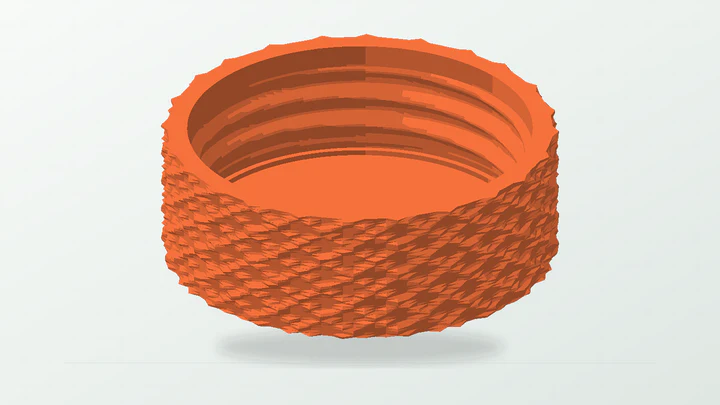
A prototype closure derived from measured thread geometry—not a certified cap, seal or container component for fuel, chemicals, pressure, transport or hazardous contents.
The starter dimensions are there to make the controls understandable. Replace them with evidence from the real part, space and print setup.
Measure crest and root diameters at several positions and check whether the real profile is tapered, damaged or out of round.
Count axial pitch and thread starts separately, establish lead and confirm the turning direction before modelling the helix.
Record ridge width, the axial position of the first complete thread and any unthreaded rim lead-in needed for assembly.
Measure the actual lip, available deck, gasket section and compression plan independently of the thread dimensions.
These values produce the preview shown above. They remain editable after the template opens in the EazyMake studio.
The generator keeps the important decisions visible and carries one parameter set through geometry, inspection, calibration and export.
Capture diameters, pitch, starts, handedness, profile, ridge width and entry position rather than scaling a visually similar cap.
Choose wall, height, top thickness, grip and lead-in while preserving enough material around the internal thread and gasket deck.
Enter a recess only after measuring the lip and gasket; thread engagement does not define squeeze or sealing behaviour.
Test the tighter, selected and looser female rings on the cleaned, empty counterpart using the final print setup.
Inspect thread entry and recess backing in the slicer, then test thread and gasket behaviour separately within a safe non-hazardous plan.
Answers specific to this starter and the measurements it exposes.
Thread depth is radial: half the difference between the 38 mm major diameter and 35.2 mm minor diameter, giving 1.4 mm.
Yes only because the starter uses one thread start. Pitch is 3.5 mm and lead is pitch multiplied by starts, so the one-start lead is also 3.5 mm.
No. The recess is measured geometry only. Gasket material, lip condition, compression, cap stiffness, contents, pressure and repeated use all need separate validation.
The rings isolate thread engagement and compare three clearances quickly. They reduce print time while keeping the real counterpart and final print setup in the experiment.
Use the guide when you need the reasoning, or open another template to see the same measurement-first workflow in a different part family.
Open the real generator, replace the example dimensions and keep the calibration result tied to your printer and material.